The Service Container
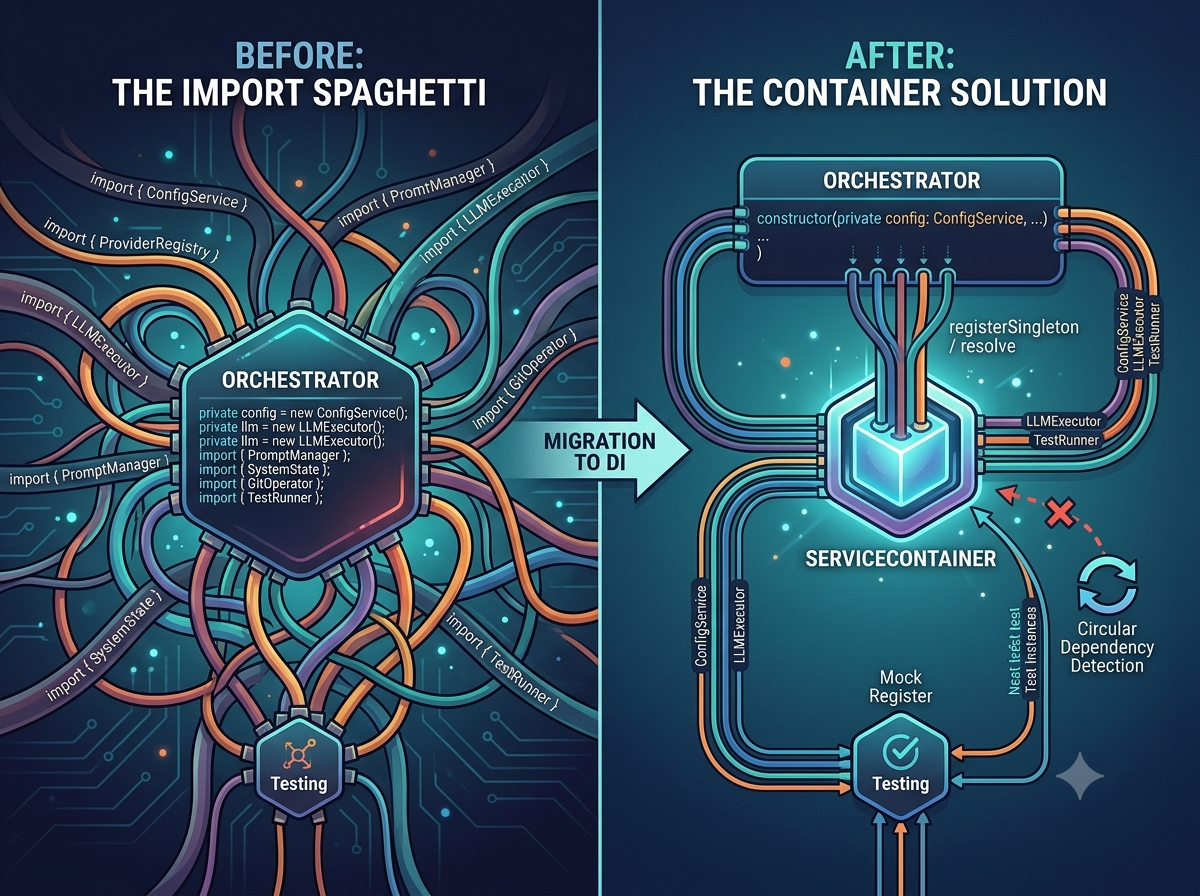
The Import Spaghetti
Before the ServiceContainer, Dairector’s classes looked like this:
import { ConfigService } from '../config/ConfigService';
import { ProviderRegistry } from '../providers/ProviderRegistry';
import { LLMExecutor } from '../execution/LLMExecutor';
import { PromptManager } from '../prompts/PromptManager';
import { SystemState } from '../domain/SystemState';
import { GitOperator } from '../git/GitOperator';
import { TestRunner } from '../testing/TestRunner';

class Orchestrator {
  private config = new ConfigService();
  private providers = new ProviderRegistry();
  private llm = new LLMExecutor();
  private prompts = new PromptManager();
  private state = new SystemState();
  private git = new GitOperator();
  private tests = new TestRunner();
}
Every class was tightly coupled to its dependencies. Testing meant importing everything. Changing a constructor signature meant updating every file that created that class.
The Container Solution
The ServiceContainer is a simple DI container:
class ServiceContainer {
  private static instance: ServiceContainer;
  private factories = new Map<string, FactoryDefinition>();
  private singletons = new Map<string, any>();
  private resolving = new Set<string>(); // Circular dependency detection

  static getInstance(): ServiceContainer {
    if (!this.instance) {
      this.instance = new ServiceContainer();
    }
    return this.instance;
  }

  registerSingleton<T>(name: string, factory: () => T): void {
    this.factories.set(name, { factory, type: 'singleton' });
  }

  registerTransient<T>(name: string, factory: () => T): void {
    this.factories.set(name, { factory, type: 'transient' });
  }

  resolve<T>(name: string): T {
    // Circular dependency check
    if (this.resolving.has(name)) {
      throw new Error(`Circular dependency detected: ${name}`);
    }

    const definition = this.factories.get(name);
    if (!definition) {
      throw new Error(`Service not registered: ${name}`);
    }

    // Singleton: return cached instance
    if (definition.type === 'singleton') {
      if (!this.singletons.has(name)) {
        this.resolving.add(name);
        this.singletons.set(name, definition.factory());
        this.resolving.delete(name);
      }
      return this.singletons.get(name);
    }

    // Transient: create new instance each time
    this.resolving.add(name);
    const instance = definition.factory();
    this.resolving.delete(name);
    return instance;
  }
}
The Orchestrator After
With the container, the Orchestrator becomes clean:
class Orchestrator {
  constructor(
    private config: ConfigService,
    private providers: ProviderRegistry,
    private llm: LLMExecutor,
    private prompts: PromptManager,
    private state: SystemState,
    private git: GitOperator,
    private tests: TestRunner
  ) {}
}

// Registration
container.registerSingleton('ConfigService', () => ConfigService.getInstance());
container.registerSingleton('ProviderRegistry', () => ProviderRegistry.getInstance());
container.registerTransient('Orchestrator',
  () => new Orchestrator(
    container.resolve('ConfigService'),
    container.resolve('ProviderRegistry'),
    container.resolve('LLMExecutor'),
    container.resolve('PromptManager'),
    container.resolve('SystemState'),
    container.resolve('GitOperator'),
    container.resolve('TestRunner')
  )
);
Testing Made Simple
The container makes testing trivial. Register mock implementations:
// In tests
container.registerSingleton('ConfigService', () => ({
  getModelConfig: jest.fn().mockReturnValue(mockConfig),
  getStageConfig: jest.fn().mockReturnValue(mockStageConfig)
}));

container.registerSingleton('ProviderRegistry', () => ({
  createProvider: jest.fn().mockReturnValue(mockProvider)
}));

const orchestrator = container.resolve<Orchestrator>('Orchestrator');
No more complex setup. No more importing 15 files just to test one class.
The Circular Dependency That Almost Broke Me
The container caught a circular dependency I didn’t know existed. FlowOrchestrator depended on CommandHandler, which depended on FlowOrchestrator. The container threw an error at registration time instead of letting it crash at runtime.
This alone was worth the migration. The container acts as a compile-time check on your architecture. If you have circular dependencies, you know immediately.
What I’d Do Differently
The container is simple — maybe too simple. I’d add:
- Auto-resolution: Infer dependencies from constructor parameters
- Scoped lifetimes: Create instances per-pipeline-run instead of per-app
- Disposal: Clean up resources when services are no longer needed
But for a VS Code extension, the current design is good enough. It’s lightweight, testable, and catches the most common problems.
Next post: The Invalidation Cascade — How Context Changes Propagate Through the Pipeline